
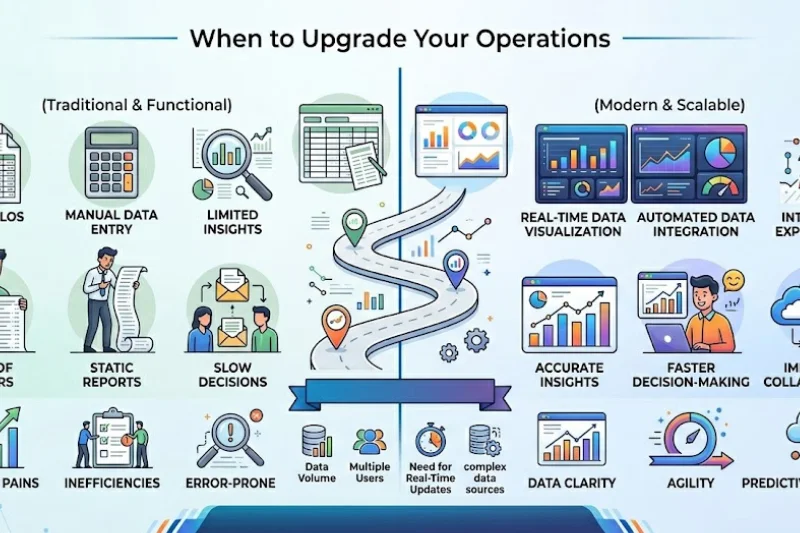
Business Dashboards vs Spreadsheets: When to Upgrade Your Operations
For many businesses, spreadsheets are where operations begin. They are familiar, flexible, and useful for early-stage tracking. Many companies use them for sales logs, expenses, customer lists, reporting, and task management. But as a business grows, spreadsheets can become harder to manage. Files multiply, formulas break, versions get mixed up, and reporting takes longer than…
For many businesses, spreadsheets are where operations begin. They are familiar, flexible, and useful for early-stage tracking. Many companies use them for sales logs, expenses, customer lists, reporting, and task management.
But as a business grows, spreadsheets can become harder to manage. Files multiply, formulas break, versions get mixed up, and reporting takes longer than it should. That is when the question becomes important: business dashboards vs spreadsheets — which is right for your next stage of growth?
At Nyvian, we help businesses move from manual tracking systems to smarter operational tools built for speed, clarity, and scale.
Why Spreadsheets Work in the Beginning
Spreadsheets are valuable because they are:
- Low cost
- Easy to start with
- Flexible for custom tracking
- Useful for simple calculations
- Familiar to most teams
For smaller operations, spreadsheets can be enough.
Where Spreadsheets Start to Fail
As operations become more complex, spreadsheets often create friction.
Common issues include:
- Multiple versions of the same file
- Manual data entry errors
- Broken formulas
- Slow reporting processes
- Limited real-time visibility
- Poor collaboration across teams
- Difficult scaling as data grows
These problems cost time and reduce confidence in decision-making.
What Is a Business Dashboard?
A business dashboard is a live system that displays important business data in one place. It can connect metrics, workflows, reports, and operational insights into a clear visual view.
Instead of searching through files, leaders can see performance instantly.
Examples include:
- Sales performance dashboards
- Team productivity dashboards
- Operations dashboards
- Customer service dashboards
- Financial reporting dashboards
Business Dashboards vs Spreadsheets: Key Differences
Real-Time Data
Dashboards update automatically. Spreadsheets often require manual updates.
Better Visibility
Dashboards present key metrics clearly. Spreadsheets can become cluttered and hard to read.
Fewer Errors
Integrated systems reduce manual entry and formula mistakes.
Faster Decisions
Leaders can act quickly when insights are visible in real time.
Scalability
Dashboards handle growing operations more effectively than scattered files.
When Should You Upgrade to a Dashboard?
It may be time to upgrade your operations if:
- Reporting takes too long
- Teams rely on multiple spreadsheets
- Data errors are increasing
- You need real-time visibility
- Growth is making operations harder to manage
- Decision-making feels slow or unclear
Frequently Asked Questions
Are spreadsheets still useful for business?
Yes. Spreadsheets are useful for simple tracking, early-stage businesses, and lightweight analysis.
What is the benefit of a business dashboard?
A dashboard improves visibility, reporting speed, decision-making, and operational efficiency.
Can small businesses use dashboards?
Yes. Dashboards are valuable for businesses of all sizes when operations become more complex.
Final Thoughts
Spreadsheets are a strong starting tool, but they are not always the best long-term system.
The right time to upgrade is when your tools begin slowing progress instead of supporting it.
If your business is ready to replace scattered spreadsheets with custom dashboards, reporting systems, or smarter internal tools, Nyvian helps build solutions designed for growth.